The World of Panchavadyam
The World of Panchavadyam : When Five Instruments Become One
satNRag
6/9/20265 min read
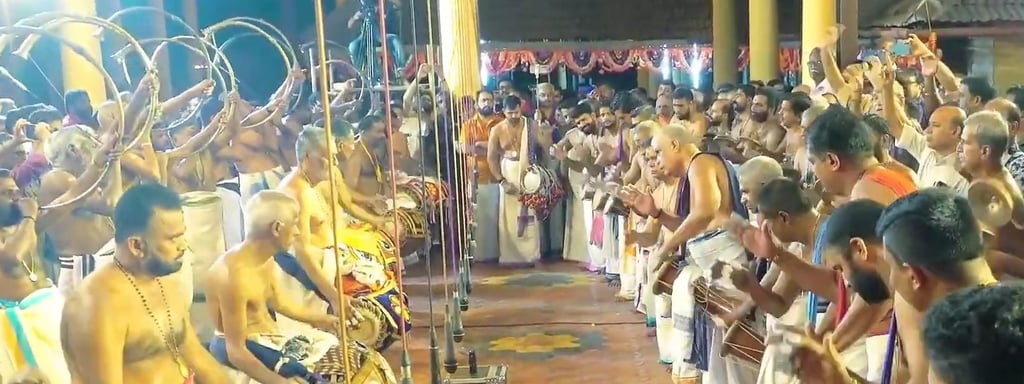
Imagine standing in the forecourt of a Kerala temple as the sun dips low. Around you, a sea of people — pilgrims, musicians, onlookers, devotees — all held in a kind of collective stillness. And then it begins. Slowly. Almost tentatively. A rhythm so unhurried it feels like breathing. Within minutes, something shifts: the tempo tightens imperceptibly, the sound thickens, and by the time you realise what is happening, the music has taken hold of you completely. Your heartbeat has adjusted to the drum. The air itself seems to vibrate.
This is Panchavadyam — and there is nothing else in the world quite like it.
Five Instruments, One Voice
The name says it plainly: Pancha means five, vadyam means instrument. Panchavadyam is a classical Kerala temple ensemble built around five specific instruments — four percussion and one wind — played together in a tightly structured, mathematically precise crescendo that builds over the course of approximately two hours towards a thundering, ecstatic climax.
TimilaA glass-shaped jackwood drum suspended from the shoulder, played with both palms. The lead instrument — the timila player anchors and conducts the entire ensemble.
MaddalamA barrel-shaped drum made from jackfruit wood, played on both sides. Considered a Deva Vadyam — an instrument of the gods — associated with the cosmic dance of Shiva.
IdakkaThe hourglass drum — small, sensitive, and uniquely expressive. Played with one hand while the other manipulates tension cords to alter pitch mid-stroke.
IlathalamA pair of small bronze cymbals that keep the fundamental rhythmic cycle. Understated, but the heartbeat of the entire composition.
KombuThe lone wind instrument — a C-shaped brass horn whose shrill, piercing blare cuts through the percussion and marks the structural turning points of the performance.
What makes the ensemble remarkable is how these five very different voices — from the deep resonance of the maddalam to the sharp cry of the kombu — are not playing melody in any conventional sense. They are weaving rhythmic counterpoint: complementing, answering, and building on each other more in the manner of Western orchestral harmony than the melodic tradition of Indian classical music. It is, in that sense, a uniquely Keralite invention.
Older Than It Looks
Copper plates and rock inscriptions from as far back as the 9th century CE mention the term "Panchavadyam," hinting at an ancient lineage. But scholars are careful to note that whatever ensemble those early references described was likely very different from the form we know today. The Panchavadyam in its current, elaborate shape was formulated in the first half of the 20th century — specifically the 1930s — in central Kerala.
The architects of this modern form were a small group of extraordinary musicians: maddalam maestros Venkichan Swami (formally Thiruvillwamala Venkateswara Iyer) and his disciple Madhava Warrier, working alongside timila masters Annamanada Achutha Marar and Chengamanad Sekhara Kurup. Later, the idakka virtuoso Pattirath Sankara Marar refined the ensemble further. These are not household names beyond Kerala, but the art form they shaped has since been heard — and felt — by millions.
The Architecture of Sound
A Panchavadyam performance is a study in structured inevitability. It opens in a slow, meditative register — the rhythmic cycles are long, the tempo unhurried. Gradually, with almost mathematical precision, the tempo accelerates while the number of beats within each cycle is halved, then halved again. The ensemble is building a pyramid of rhythm, and the audience rides it.
A typical performance lasts around two hours, with the crescendo arriving like a wave the listener both anticipates and cannot quite prepare for. At Peruvanam Temple, known for its exceptional Panchavadyam tradition, marathon performances accompanying all-night rituals can stretch to six hours or more. A major ensemble will bring together up to 60 musicians, arranged in a specific formation: the timila player at the centre front, maddalam players facing them, ilathalam players flanking, kombu players at the rear, and two idakka players on either side of the central aisle.
The most celebrated Panchavadyam in the calendar is the Madhathil Varavu at the Thrissur Pooram — Kerala's grandest temple festival — held at the Vadakkunnathan Temple in Thrissur. Here, the ensemble performs in front of caparisoned elephants, the escalating rhythms seemingly guiding the procession itself. To witness it is to understand why Panchavadyam is described not just as music but as a force.
✦ Did You Know?
The Panchavadyam's rhythmic structure has been compared to a fractal — as the tempo doubles, the internal pattern of each cycle mirrors the whole, creating a self-similar architecture that builds towards the climax. Listeners often describe the experience as simultaneously mathematical and deeply emotional.
The timila player does not just play — they conduct. Through subtle cues in their own playing, the lead timila artist signals tempo changes and structural shifts to the entire ensemble of up to 60 musicians, all without stopping, without a baton, and without missing a beat.
Oscar-winning sound designer Rasool Pookutty, who grew up in Kerala, recorded a celebrated version of the Thrissur Pooram Panchavadyam — bringing international-standard acoustic capture to one of Kerala's most ancient sonic traditions.
♪ Recommended Listening
Panchavadyam at Thrissur Pooram 2025 — Majestic temple drums in front of elephants at Vadakkunnathan Temple. The gold standard of Panchavadyam recordings. Search "Panchavadyam Thrissur Pooram 2025" on YouTube.
Thrissur Pooram Panchavadyam — recorded by Rasool Pookutty — A superbly captured version by Kerala's most famous sound engineer. Search "Thrissur Pooram Panchavadyam Rasool Pookutty" on YouTube.
Paramekkavu Panchavadyam — Thrissur Pooram — The Paramekkavu devaswom's ensemble performance, one of the two rival groups at the Pooram. Search "Paramekkavu Panchavadyam Thrissur Pooram" on YouTube.
Panchavadhyam Audio Jukebox — A studio recording featuring Akkikkavu Appunni Nair and Kothachira Sekhar, ideal for a cleaner first listen without the ambient crowd. Search "Panchavadhyam Kerala Cultural Programs Audio Jukebox" on YouTube.
Panchavadyam Instruments — A Demonstration — A short YouTube video walking through each of the five instruments individually before hearing them together. Search "Panchavadhyam Instruments Timila Maddalam Ilathalam Idakka Kombu" on YouTube.
More Than Music
There is a reason Panchavadyam is performed in temples and not concert halls — or at least, that is where it was born and where it remains most fully itself. The mathematics of its structure, the sacred associations of its instruments (the maddalam as Deva Vadyam, the idakka as the voice of the feminine), the communal act of listening as the tempo rises — all of this belongs to a world where music is not entertainment but offering. Something given to the divine, and in the giving, something extraordinary happens to everyone present.
Panchavadyam has, of course, moved beyond temple courtyards in recent decades — it is performed at cultural festivals, on concert stages, and increasingly before international audiences who encounter it with no prior knowledge and leave shaken by what they felt. That perhaps says everything. You do not need to understand a single thing about tala or percussion theory to be moved by Panchavadyam. You only need ears, and a willingness to let the rhythm find you.
There is a moment near the end of a Panchavadyam — when the tempo has reached its peak and the air itself seems to be ringing — where thought stops entirely. You are no longer listening. You are simply inside it. That, I think, is what Kerala's ancient temple musicians were always reaching for. Not applause. Not admiration. Just that moment of complete surrender to the sound.