The King of Ghazal
Remembering Mehdi Hasan
satNRag
6/15/20264 min read
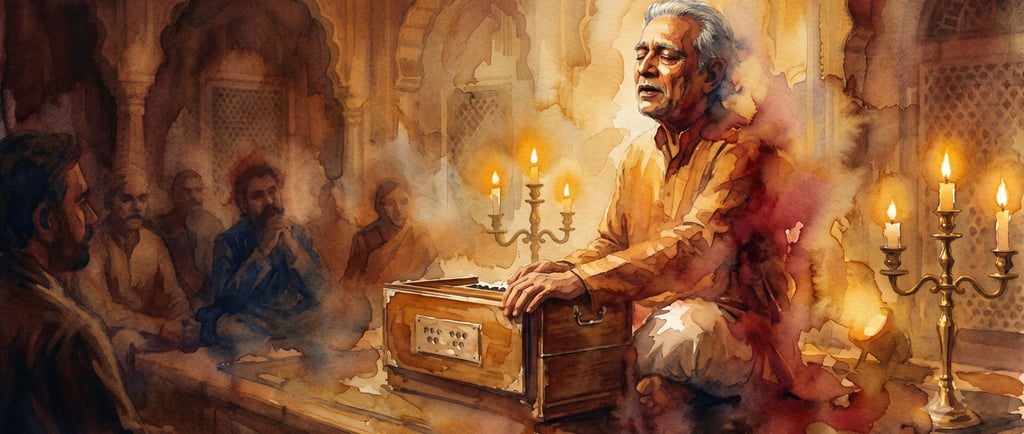
There is a particular kind of silence that falls in a room when Mehdi Hasan begins to sing. Not the polite quiet of an audience waiting for a performance to start — but something deeper, almost involuntary. A held breath. As if the air itself pauses to listen. That is the power of a voice that Lata Mangeshkar, the nightingale of India herself, once described with these unforgettable words: "Apke gale mein Bhagwan bolte hain" — "God speaks through your throat."
If you have never heard Mehdi Hasan, stop reading right now and go listen. And if you already have — then you already know what this post is about.
From the Dust of Rajasthan to the Throne of Ghazal
Mehdi Hasan Khan was born on 18 July 1927 in Luna, a small village in Rajasthan, India. He came from a family of Kalawant musicians — hereditary artists who claimed an unbroken lineage of sixteen generations of music-making. His father was a Dhrupad singer; his uncle a formidable influence. Music was not a career choice for young Mehdi. It was simply what the family breathed.
And then came Partition.
In 1947, the family crossed over to the newly formed Pakistan, leaving behind their roots, their patrons, and much of their world. The young man who had sung for the kings of Jaipur and Baroda now found himself in a strange city with no guarantee of tomorrow. To survive, Mehdi Hasan took up work at a bicycle repair shop in Chichawatni — Mughal Cycle House — and later became a diesel tractor mechanic. The Shahanshah-e-Ghazal, the Emperor of Ghazal, once fixed engines for a living.
But he never stopped practising. Every evening, after the grease was washed off his hands, he would sit and sing. In 1952, he got his break on Radio Pakistan. Within years, a voice that had been tuning carburettors was making the whole subcontinent weep.
The Architecture of a Voice
What made Mehdi Hasan extraordinary was not just the timbre of his baritone — though that voice, deep and honeyed with an ache at its core, was unlike anything before or since. It was his musicianship. Trained rigorously in Dhrupad and Khayal, he brought the full weight of classical Hindustani music into the ghazal, a form that had too often been treated as light entertainment.
He approached each ghazal as a raga: understanding its mood, its scale, its emotional architecture. "Ranjish Hi Sahi," set to the late-evening colours of Raga Yaman, wasn't just a song to him. It was a complete emotional landscape. He shaped each sher (couplet) like a sculptor — knowing where to let the voice fall into shadow, where to let it soar.
He also had an extraordinary gift for Urdu poetry. He drew from Ghalib, Mir, Faiz Ahmed Faiz, Ahmad Faraz, and Iqbal — treating their verses not as lyrics to be set to a tune, but as living texts to be inhabited. Listeners didn't just hear the melody. They felt the poetry.
A Bridge Across Borders
Perhaps no artist of the 20th century did more to stitch together the musical hearts of India and Pakistan. In 1977, when Lata Mangeshkar heard him live in Delhi, she was moved to tears and made her now-legendary remark. In 2011, just a year before his passing, the two recorded a duet together for the album Sarhadein (Borders) — a long-cherished dream for both artists and a moment of extraordinary artistic grace between two nations whose governments rarely agreed on anything.
He was equally beloved by singers like Ghulam Ali, Jagjit Singh, and Pankaj Udhas, all of whom acknowledged his towering influence. To be a ghazal singer in South Asia after Mehdi Hasan was to sing in his shadow — and most accepted that shadow with reverence.
Did You Know?
Mehdi Hasan was initially known as a thumri singer, not a ghazal singer. He began on Radio Pakistan singing thumri and light classical, and only gradually shifted to ghazals — which would go on to define his legacy.
During his years of hardship after Partition, he worked as a bicycle and tractor mechanic. Years later, when his harmonium broke backstage at a concert, he began fixing it himself — and laughed, saying it was nothing compared to repairing a diesel engine.
He recorded an album with sarangi maestro Ustad Sultan Khan — considered the only full sarangi-accompanied album in his catalogue, and a treasure for connoisseurs of classical-rooted ghazal.
A Personal Note — My Favourite
Of all the ghazals in the world, Ranjish Hi Sahi is the one that has stayed with me the longest. Written by Ahmad Faraz — himself one of Urdu's most tender voices — and sung by Mehdi Hasan in the colours of Raga Yaman, it is a ghazal about longing that somehow transcends longing itself.
"Ranjish hi sahi, dil hi dukhane ke liye aa..." — Even if it's only bitterness that brings you, come. Even if it's just to break my heart again, come. There is something in that plea — so honest, so stripped of pride — that feels like the truest thing any poem has ever said about love. And in Mehdi Hasan's voice, it doesn't feel like performance. It feels like confession. I have listened to it in the early morning, late at night, in moments of joy and grief. It has never once let me down.
🎵 Recommended Listening
Ranjish Hi SahiPoetry by Ahmad Faraz. Set in Raga Yaman. The definitive recording — available on YouTube and Spotify. Begin here.
Patta Patta Boota BootaPoetry by Mir Taqi Mir. A masterclass in how classical ragas can breathe inside a ghazal. Haunting and majestic.
Gulon Mein Rang BharePoetry by Faiz Ahmed Faiz. Perhaps the most famous Faiz ghazal ever recorded — Mehdi Hasan's version remains the gold standard.
Baat Karni Mujhe MushkilA beloved film ghazal with extraordinary emotional depth. Available on most streaming platforms under various Mehdi Hasan compilations.
Sarhadein (Album, 2011)His duet album with Lata Mangeshkar — two legends, one final collaboration. A historical document as much as music.
A Voice That Time Cannot Silence
Mehdi Hasan Khan passed away on 13 June 2012 in Karachi, after years of illness that had gradually robbed him of speech and movement. He was 84. In his final years, he could barely walk. But those who visited him said that even then, he would sometimes hum softly — as if the music was still there, still trying to find its way out.
He left behind not just recordings, but a complete vision of what the ghazal could be: serious, classical, deeply literary, and still capable of breaking a heart open in a single phrase. He showed that popular music need not be shallow, and that classical music need not be cold.
"A voice like Mehdi Hassan's may never be heard again."— Lata Mangeshkar, on his passing, 2012
If you are coming to Mehdi Hasan for the first time, you are about to receive a gift. And if you have loved him for years — well, you already know. Some voices don't just fill the air. They fill something inside you that you didn't know was empty.