Mizhavu - The Sacred Copper Drum
Mizhavu and the World of Kutiyattam
satNRag
5/10/20264 min read
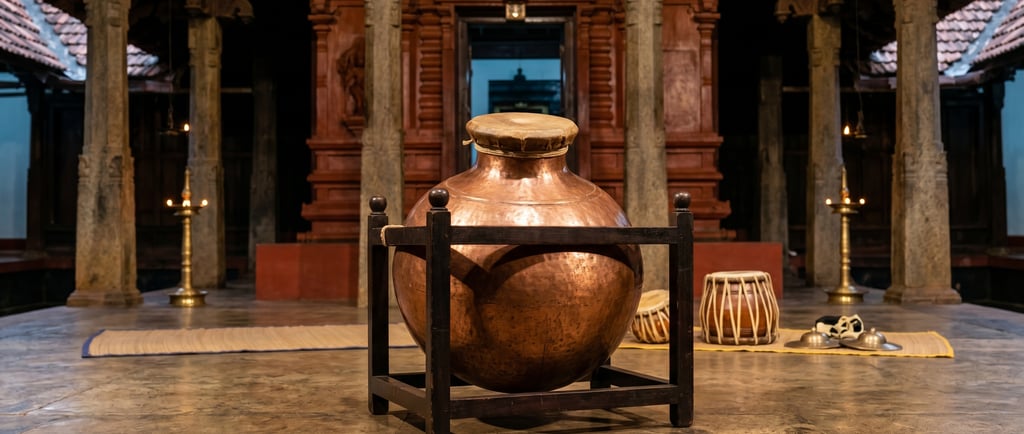
Somewhere in a Kerala temple theatre, before the actors take the stage and long before the lamps are lit, a man sits down before a large copper vessel — shaped like a pot, as tall as a child — and begins to play. No sticks. No mallets. Only his bare palms and fingertips against the stretched hide that covers its mouth. The sound that rises is deep, resonant, ancient. It seems to come not from an instrument but from the earth itself.
This is the Mizhavu. And once you've heard it, you don't easily forget it.
A Drum Like No Other
The Mizhavu is the principal percussion instrument of Kutiyattam — Kerala's Sanskrit theatre tradition and the oldest surviving form of classical theatre in the world. Large, pot-shaped, and made of copper or clay with a skin stretched over its open mouth, the Mizhavu is played exclusively with the hands: the fingertips strike the membrane for sharp, high tones, while the full palm drives out the deep bass that gives the instrument its unmistakable weight and presence.
Unlike most percussion instruments that are portable and brought to the performer, the Mizhavu is fixed in place — it sits on a pedestal in the theatre's music area, and the player comes to it, often for performances that can last many hours, or even many days. The instrument does not travel lightly. Neither does the tradition it carries.
Ancient Enough to Touch the Gods
The Mizhavu's history is old enough that tracing it feels less like scholarship and more like archaeology. Its association with Kutiyattam places it in Kerala's cultural landscape as far back as the 9th or 10th century CE, though references in the Natya Shastra — the foundational Sanskrit treatise on the performing arts, attributed to Bharata Muni and estimated to be nearly 2,000 years old — suggest the instrument's lineage is older still. The Natya Shastra classifies it as an Urdha Mukha Mridangam (the upward-facing drum) and describes it as a Deva Vadyam — literally, an instrument of the gods.
The Nambiar community, who traditionally played the Mizhavu for generations, trace its divine origin even further. According to their tradition, the instrument was born from the cosmic dance of Lord Shiva, played by Nandikeswara — the divine bull who is Shiva's gatekeeper and chief musician. This is not mythology for its own sake; it explains the extraordinary reverence with which the Mizhavu has always been treated. The instrument is accorded the sacred status of Brahmacharya — the standing of a celibate Brahmin scholar — and treated accordingly within the ritual space of the temple theatre.
The Nambiars: Custodians of a Tradition
For centuries, the Mizhavu was the exclusive domain of the Ambalavasi Nambiar community. Their very Sanskrit title — Pānivāda, meaning "one who plays with the hands" — describes their art. This was not merely a profession but a sacred calling, passed from father to son through generations of devoted practice.
Students were famously not permitted to touch the copper drum until they had spent long months conditioning their hands by practicing on stones and wooden blocks. The body had to earn the right to approach the instrument. Even the manufacturing of the Mizhavu remains a closely held craft — the primary centre for making these drums is near Irinjalakkuda in Thrissur district, with only a handful of master artisans possessing the knowledge to craft one properly.
In 1965, when the Kerala Kalamandalam began formally teaching Kutiyattam, the caste restriction on who could play the Mizhavu was finally broken. The tradition was opened — carefully, and with respect for its origins — to a wider community of learners.
The Maestro: P.K. Narayanan Nambiar
Guru P.K. Narayanan Nambiar is the name most closely associated with the Mizhavu in the modern era. The only Mizhavu artist to receive the Padma Shri, Nambiar not only carried the tradition forward with consummate skill but actively expanded it. Together with his disciple Kalamandalam Easwaran Unni, he pioneered Mizhavu Thayambaka — a solo percussion concert format for the Mizhavu, allowing the instrument to be heard and appreciated on its own terms, outside of its traditional theatrical context. That a 1,000-year-old temple instrument now commands its own solo concert stage is entirely due to Nambiar's vision. His other key disciples — V.K.K. Hariharan and Edanadu Unnikrishnan Nambiar — continue to carry this legacy forward.
✦ Did You Know?
The Mizhavu is considered a Deva Vadyam — an instrument of the gods — in the Natya Shastra, giving it a sacred status that most percussion instruments in the world do not share. It is treated within the performance space not as an object but almost as a presence.
Kutiyattam was the first performing art in the world to be recognised by UNESCO as a Masterpiece of the Oral and Intangible Heritage of Humanity — in 2001, before the wider Intangible Heritage Convention was formalised. The Mizhavu is inseparable from that recognition.
Traditional Mizhavu students practiced for months on stones and wooden blocks before they were ever allowed to touch the copper drum — a discipline designed to harden the palms and cultivate patience in equal measure.
♪ Recommended Listening
Mizhavu Thayambaka — P.K. Narayanan Nambiar — The legendary maestro in a solo demonstration. Essential listening for anyone curious about what this instrument can do on its own. Search "Mizhavu Thayambaka PK Narayanan Nambiar" on YouTube.
Mizhavu Percussion in Kutiyattam Sanskrit Theatre — A documentary-style YouTube video showing the Mizhavu in its natural theatrical context. Search "Mizhavu Percussion instrument Kutiyattam Sanskrit theatre" on YouTube.
Mizhavu Orchestra — Koothu and Kutiyattam — A recording of the full percussion ensemble as heard in performance. Search "Mizhavu Orchestra Traditional Drum Koothu Kutiyattam Kerala" on YouTube.
Chalakudy Mahotsavam — Mizhavu Thayambaka (2024) — A more recent solo performance from the living tradition. Search "Chalakudy Mahotsavam Mizhavu Thayambaka" on YouTube.
Sahapedia: Mizhavu and Other Musical Instruments in Kutiyattam — Not audio, but an authoritative written and visual guide at sahapedia.org — a wonderful companion resource for deeper reading.
Still Sounding After a Thousand Years
There is something quietly remarkable about an instrument that has been played in temple theatres for over a thousand years and is still being played today — not as a museum relic or a heritage curiosity, but as a living, breathing part of a performance tradition that continues to evolve. The Mizhavu Thayambaka concerts that P.K. Narayanan Nambiar helped establish are now a recognised art form in their own right, drawing audiences who may never have seen a Kutiyattam performance but are drawn to the deep, meditative power of this copper drum played with bare hands.
In a world of amplified sound and synthetic beats, there is something deeply grounding about music that asks only for a pair of trained hands, a copper vessel, and a room willing to listen.
The Mizhavu does not announce itself. It simply begins — and before long, you realise the room has changed. The air is different. Something ancient has entered. That is, perhaps, what a Deva Vadyam is supposed to do.