Bhavayami Raghuramam
A Ragamalika for the Rains of Karkidakam
satNRag
7/20/20264 min read
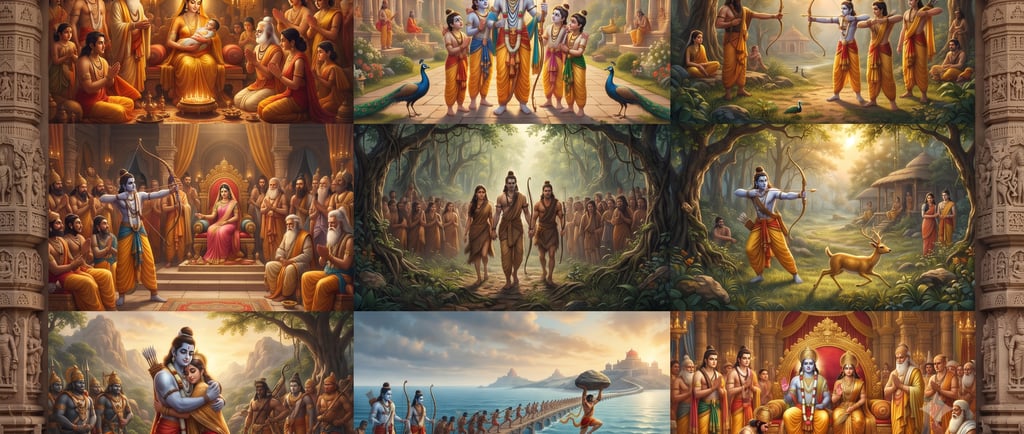

Right now, as this is being written, Kerala is deep in Karkidakam — the last month of the Malayalam calendar, when the monsoon settles in for good and, in home after home, an oil lamp is lit each evening for the reading of the Ramayanam. It felt like the right month to sit with one composition that does something remarkable: it takes the entire sweep of the epic — birth to coronation, forest exile to the burning of Lanka — and folds it into a single, twelve-minute song. That song is Swati Tirunal's Bhavayami Raghuramam, and it's also the piece I built a nine-minute video around, tracing Sreerama's story from his birth to his coronation, with my sister Santhi Subhash reciting it.
Why Karkidakam Became Ramayana Masam
Karkidakam wasn't always thought of as a holy month. For generations of Kerala's agrarian households, it was dreaded — the fields lay fallow, the rains cut off travel and trade, and the season was known bluntly as Panja Karkidakam, the month of scarcity. With little work to be done and even less to eat, families turned inward, and that turning inward found its shape in the Adhyatma Ramayanam Kilippattu, the Malayalam retelling of the epic composed in the 16th century by Thunchath Ezhuthachan, revered as the father of Malayalam literature. Reading a chapter aloud each evening became a quiet discipline — not a performance, just a family gathered around a lamp.
The month's identity as Ramayana Masam in its more organised, public form is newer than most people assume — Kerala has formally observed it this way for a little over four decades, since a cultural revival in 1982 brought the tradition out of individual homes and into temples, radio broadcasts, and community readings across the state. What began as a private ritual to survive a hard season became a shared act of memory, and Karkidakam — once feared — is now the month Kerala turns most deliberately toward Rama.
A King Who Composed the Ramayana Into Seven Ragas
Bhavayami Raghuramam comes from a very different setting than a village home reading the Kilippattu by lamplight — it was composed by Maharaja Swati Tirunal of Travancore (1813–1846), a ruler who was also one of Carnatic music's most prolific composers, leaving behind some 400 works in Sanskrit, Malayalam, Telugu, Kannada, and Hindustani styles. He wrote Bhavayami Raghuramam originally as a single-raga kriti in Saveri, set to Rupaka talam. It took more than a hundred years and the genius of Semmangudi Srinivasa Iyer, one of the towering figures of 20th-century Carnatic music, to reimagine it as a ragamalika — a garland of ragas — adding cittasvarams and letting each verse move into a new raga: Saveri, Nattakurinji, Dhanyasi, Mohanam, Mukhari, Poorvikalyani, and Madhyamavati.
What makes the composition extraordinary is its economy. Valmiki's Ramayana runs to roughly 24,000 verses. Swati Tirunal compresses the whole of it — Rama's birth, the breaking of Shiva's bow, the exile, Ahalya's redemption, the defeat of Ravana, the return to Ayodhya — into just six charanams, one for each Kanda of the epic. It's less a song than a map of the entire story, small enough to hold in a single sitting and vast enough to contain everything.
The Voices Behind the Verses
Swati Tirunal gave the composition its bones — a king-composer whose court in Thiruvananthapuram drew musicians like Kannayya Bhagavathar, a direct disciple of Tyagaraja, and the legendary Tanjore Quartet. Semmangudi Srinivasa Iyer gave it its wings, transforming a single-raga kriti into the seven-raga ragamalika that's performed today. And it was M.S. Subbulakshmi who carried it into every household — her recording, released commercially on HMV, became so widely heard that for decades it was simply assumed to be how the composition had always existed.
There's something fitting about a composition built for retelling being retold again and again — by D.K. Pattammal in her own recorded version, by generations of Carnatic vocalists in December's music season, and now, in a smaller and much more personal way, by my sister Santhi Subhash, whose recitation carries the piece through this video.
Did You Know?
Bhavayami Raghuramam existed for over a hundred years as a single-raga composition in Saveri before Semmangudi Srinivasa Iyer reworked it into the seven-raga ragamalika we know today.
Each of the six charanams corresponds to one Kanda of the Ramayana — meaning the entire epic's structure is embedded in the song's architecture, not just its words.
Karkidakam's reputation as "the cursed month" is old and well-documented in Kerala's agrarian memory — it's only since 1982 that its public identity as Ramayana Masam took the form we recognise today, with organised readings, discourses, and broadcasts.
Recommended Listening
M.S. Subbulakshmi — the definitive HMV recording of Bhavayami Raghuramam, widely available on YouTube; the recording most listeners think of first.
D.K. Pattammal — her rendition, also on YouTube, offers a different vocal texture and phrasing on the same seven ragas.
Semmangudi Srinivasa Iyer — where possible, seek out recordings or discussions of his own singing of the piece, to hear the ragamalika arrangement from the musician who created it.
Adhyatma Ramayanam Kilippattu readings — many Karkidakam radio and temple recitations of Ezhuthachan's text are archived online and make a lovely companion listen alongside the kriti.
My own video (embedded above, or watch on YouTube) — Santhi Subhash's recitation of Bhavayami Raghuramam, set against the story from Sreerama's birth to his coronation.
There's a particular kind of stillness that settles over Kerala in Karkidakam — rain against the roof, a lamp lit early because dusk comes fast, someone's voice reading or singing the old story once again. Bhavayami Raghuramam belongs to that stillness. It doesn't try to say anything new about Rama; it simply holds the whole story up to the light, one raga at a time, and asks you to sit with it a little longer than usual. That felt like reason enough to spend nine minutes retelling it myself, this Ramayana Masam.